
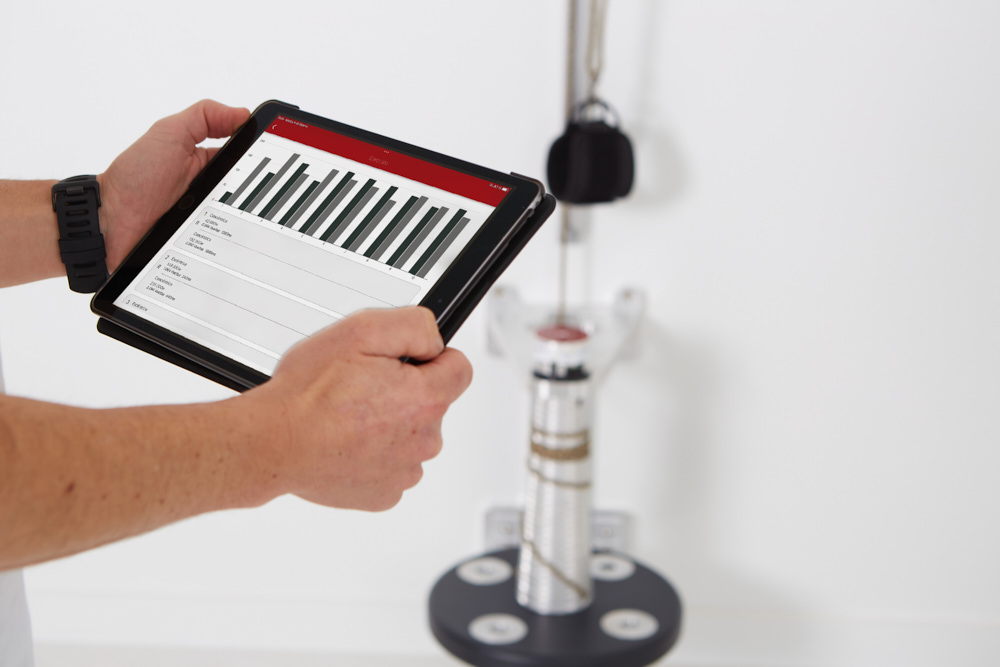
How Do We Generate ECCENTRIC OVERLOAD?
Generating eccentric overload is arguably the primary training objective of an inertial flywheel machine. Conversely, it is also one of the topics that has sparked the most controversy within the sports science community. This article describes what eccentric overload is, the best strategy to generate it, and how to measure this value using a rotary encoder.
Before we begin, we must make a crucial distinction regarding traditional weight training, as this is where all the misconceptions regarding inertial machine methodology originate.
In traditional strength training, eccentric overload is generated by subjecting the athlete to a load that exceeds their 1RM—a load they cannot lift. The goal of this training is for the athlete to control the descent of the barbell at a very low velocity, aiming to minimise the acceleration of the weight under the influence of gravity (9.8 m/s²). This is why there is a general assumption that eccentric work requires resisting very high loads at a very low velocity. The objective here is to generate high force values during the lowering phase, due to the heavy mass being displaced at a low speed.

With of an inertial machine, the objective of eccentric training is completely different and is related to the ability to brake at high velocity. We want the athlete to learn how to manage high accelerations and decelerations of light to medium loads, shifting the focus of the load from the magnitude of the weight to the acceleration of the load.
To comprehend this shift, we must keep firmly in mind how load dynamics function in an inertial machine throughout a repetition. This is the key to understanding how the eccentric load is produced and when overload can occur.
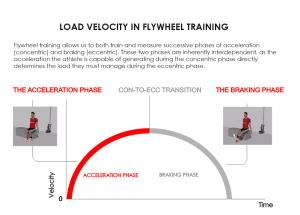
The upper graph illustrates the workload dynamics during a single repetition on a flywheel device. The load consistently maintains the same direction of rotation across two clearly distinct phases: the acceleration phase, driven by the athlete’s force application during the concentric phase, and the braking phase, driven by the athlete’s force application during the eccentric phase. While only the athlete changes their direction of movement from extension to flexion—passing through zero velocity—the load maintains the same rotational direction throughout the entire movement.
The athlete’s primary objective is the effective management of the eccentric phase. This ensures that upon completing this phase, the athlete is prepared to repeat the subsequent action with the highest possible quality, as the eccentric phase serves as the link to the start of the next action. This is precisely why it holds such high relevance in any sporting action.

What is Eccentric Overload?
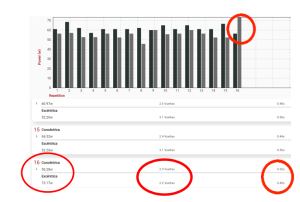
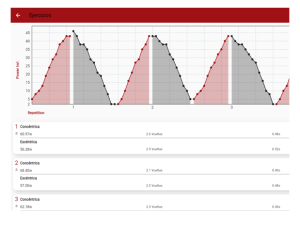
When measuring a repetition with a rotary encoder on a flywheel device, two bars representing the power output of both movement phases are displayed. The first bar represents the concentric phase power, where force is applied to accelerate the flywheel until it reaches its maximum rotational velocity. The second bar represents the eccentric phase, where force is applied to decelerate the flywheel from its maximum rotational velocity down to a complete stop.
The temporal relationship between these two phases determines the presence of eccentric overload; that is, the braking phase must be shorter than the acceleration phase.
At this stage, it is fundamental to understand that the concentric phase—the phase in which we accelerate the flywheel—determines the intensity of the eccentric phase. This occurs because the entire process hinges on the maximum rotational velocity achieved during the concentric phase.
Strategies for Generating Eccentric Overload
Various strategies exist to generate eccentric overload, yet they all hinge on the same principle: reducing the braking time to increase its intensity relative to the acceleration phase, thereby achieving a demanding braking action.
Below we outline some of these strategies:
- External assistance during the acceleration phase: This involves receiving help during the concentric phase to subsequently brake from a higher velocity than what the athlete could achieve independently. Although this method is widely used, implementing it correctly requires establishing the athlete’s maximum baseline concentric value first, in order to quantify the exact contribution of the assistance. We have observed that in many cases, this external help disrupts the athlete’s force production and alters their lifting mechanics due to a loss of tension. Consequently, the athlete initiates the braking phase with poor movement control
- Allowing a greater range of motion during the concentric phase than the eccentric phase: By reducing the distance available for the braking phase, the athlete is subjected to a more demanding deceleration. To implement this strategy, approximately 10 cm of additional rope length beyond the standard requirement should be provided. This ensures the athlete can accelerate the flywheel until the very end of the concentric phase without being restricted by their final joint range of motion.
- Utilising the transition repetition: With this strategy, the standard rope length is used. The athlete executes the concentric phase at maximum effort, subsequently attempting to brake within a shorter distance. The following repetition is soft and slow, resetting the full range of motion for the subsequent intense concentric phase. The cycle would be: R1 – transition – R2 – transition – R3 – transition…
The ideal strategy does not exist; it all depends on the specific exercise being performed and the athlete’s technical proficiency. Crucially, when implementing these strategies, we must closely monitor the two distinct ways the athlete brakes, which represent the actual targets of our training. The first is controlled braking, where the athlete progressively reduces velocity while maintaining excellent technique and motor control. This type of training is fundamental for all horizontal-plane speed variations, ensuring our athlete develops an outstanding capacity to modify both their displacement velocity and their direction.

The second braking method involves the athlete adopting a semi-flexed position, effectively blocking the movement with an almost isometric action. This type of training is more appropriate for enhancing landing mechanics and vertical-plane performance, as it is essential to arrest the descent before commencing the subsequent propulsive action.

Conclusions
- Understand the relationship between both phases: Without an optimal acceleration capacity, it is impossible to develop an effective braking capacity.
- Prioritise movement technique: Always execute exercises with sound movement mechanics, avoiding maladaptive compensations that do not align with the specific demands of the sport.
- Utilise sport-specific ranges of motion: Training must reflect the specific joint ranges of the sport, as this is where true athletic performance lies.
- Optimise training volume: Evidence and practice demonstrate that flywheel training is better tolerated when structured in sets of 5 to 8 repetitions.
If you have made it this far, I would like to thank you for your time in reading this article, and I hope it helps you to get the very best out of your flywheel device. Thank you very much.
Contact Information:
- Author: Ramón Lago Ruiloba
- Email: info@einercial.com

